7 Types of Rest
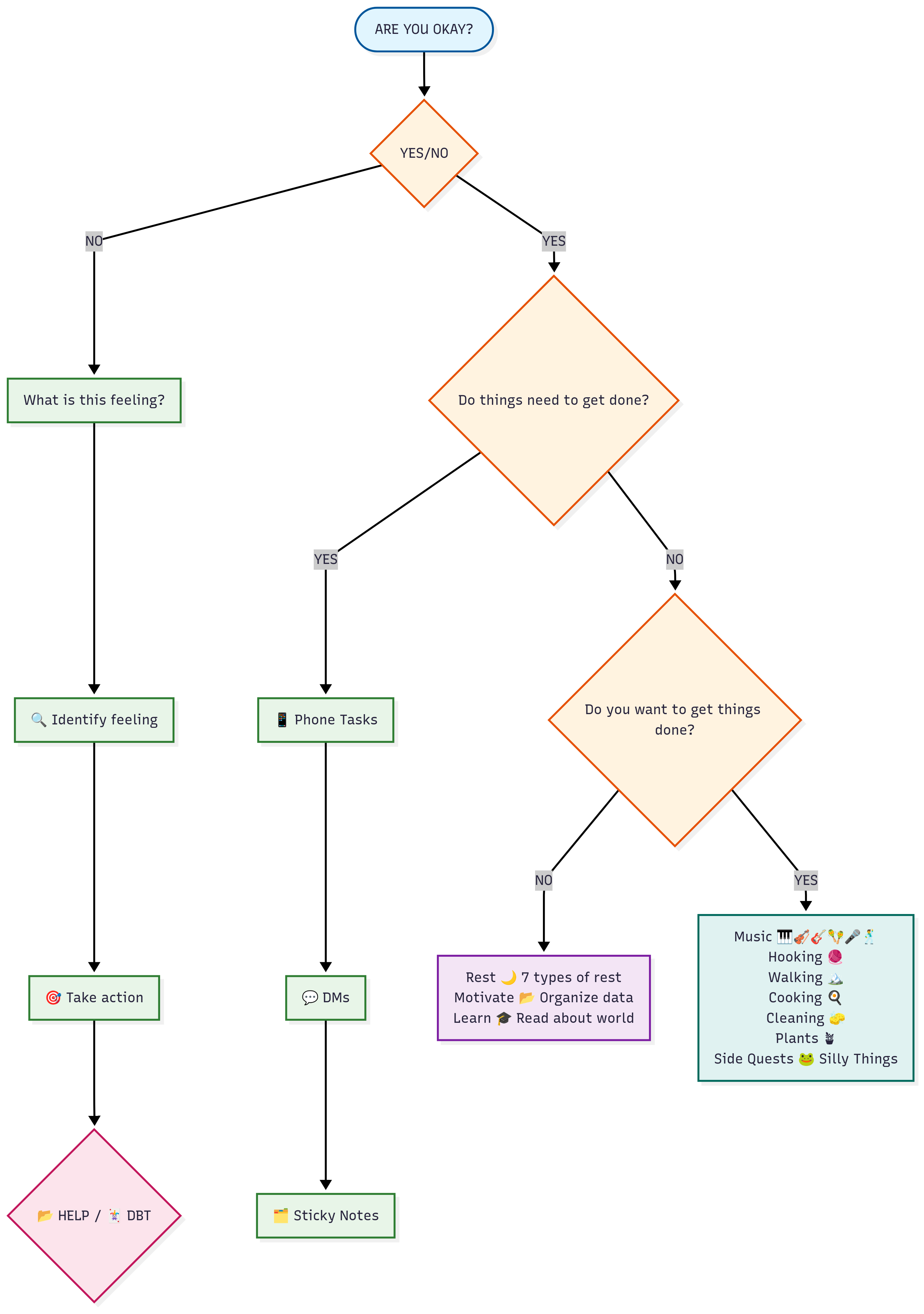
Here’s a flow chart to get us into the basic decision making flow:
ARE YOU OKAY?
│
├─ ❌ NO → What is this feeling?
│ ├─ 🔍 Identify feeling
│ ├─ 🎯 Take action
│ └─ 📂 HELP / 🃏 DBT
│
└─ ✅ YES → Do things need to get done?
|…│…│
|…│…├─ ✅ YES → Do them
|…│…│ ├─ 📱 Phone Tasks
|…│…│ ├─ 💬 DMs
|…│…│ └─ 🗂️ Sticky Notes
|…│…│
|…│…└─ ❌ NO → Do you WANT to get things done?
|…│…|…│…│
|…│…|…│…├─ ✅ YES → Same activities, your call
|…│…|…│…│ ├─ 📱 Phone Tasks
|…│…|…│…│ ├─ 💬 DMs
|…│…|…│…│ └─ 🗂️ Sticky Notes
|…│…|…│…│
|…│…|…│…└─ ❌ NO → Pick a vibe
|…│…|…│…|…│…│
|…│…|…│…|…│…├─ 🌙 REST
|…│…|…│…|…│…│ ├─ 7 types of rest
|…│…|…│…|…│…│ ├─ 📂 Motivate → Organize data
|…│…|…│…|…│…│ └─ 🎓 Learn → Read about world
|…│…|…│…|…│…│
|…│…|…│…|…│…└─ 🎉 FUN
|…│…|…│…|…│…|…│…├─ 🎹🎻🎸🪇🎤🕺 Music
|…│…|…│…|…│…|…│…├─ 🧶 Hooking
|…│…|…│…|…│…|…│…├─ 🏔️ Walking
|…│…|…│…|…│…|…│…├─ 🍳 Cooking
|…│…|…│…|…│…|…│…├─ 🧽 Cleaning
|…│…|…│…|…│…|…│…├─ 🪴 Plants
|…│…|…│…|…│…|…│…└─ 🐸 Side Quests / Silly Things
The Mermaid Tree:
Why do I need to rest?
Bestie said that it was okay. Bestie said that I need to fuel my body so I don’t crash out.
Even though I feel closer to a machine or an alien on any given day, I am still a human being with a human body that has human needs.
“El único camino para llegar adonde quiero es tratándome bien.” -My Psychologist.
AuDHD isn’t just about vibes. There’s research backing everything I feel. Autism + ADHD co-ocurring means that the wiring quirks of both these conditions are compounded. I’m not just sparkly, I’m shimmery as well, which can make it really hard to see.
Part 1: “Are you okay?” needs to happen first
ARE YOU OKAY?
├─ ❌ NO
└─ ✅ YES
The AuDHD brain has a known hardware quirk called alexithymia: trouble identifying and naming your own emotions. An estimated 50% of autistic adults and over 40% of adults with ADHD meet criteria for it.
The mechanism underneath is interoception: your brain’s ability to read internal body signals (heart rate, breath, gut, muscle tension). When interoception is fuzzy, emotions show up as vague body noise that doesn’t translate into “I am angry” or “I am exhausted” until they hit crisis volume. More recent research shows interoception is the underlying neurobiological cause of alexithymia.
🐙 Like a deep sea octopus, your nervous system is reading chemistry instead of light. The signals are there, but they don’t reach the surface unless you go looking on purpose.
Skip the check-in and jump straight to “what should I do,” and you’re trying to power through a feeling state your brain hasn’t named yet. That’s how shutdowns happen.
That’s why the first fork is mandatory. No emotional check, no good downstream choice.
Part 2: Why the “Not Okay” branch routes to identify → action → DBT 🃏
├─ ❌ NO → What is this feeling?
|…│…├─ 🔍 Identify feeling
|…│…├─ 🎯 Take action
|…│…└─ 📂 HELP / 🃏 DBT
DBT = Dialectical Behavior Therapy, a structured skills system with four modules: mindfulness, distress tolerance, emotion regulation, interpersonal effectiveness.
A 2024 randomized controlled trial of 63 autistic adults with high emotion dysregulation found:
- DBT significantly reduced emotion dysregulation post-therapy and at 6-month follow-up, with improvements in depression and quality of life
- The improvement was mediated by a decrease in alexithymia (plain English: it worked because people got better at naming feelings first)
This is exactly why the flow forces the order Identify → Action. You can’t deploy a regulation skill if you don’t know what you’re regulating. The DBT cards work because they’re an external scaffold doing the naming work your brain doesn’t auto-perform.
Part 3: Why “Need to do” vs “Want to do” is the next split 🎯
└─ ✅ YES → Do things need to get done?
└─ ❌ NO → Do you WANT to get things done?
PET brain imaging found that adults with ADHD have lower levels of dopamine receptors and transporters in the nucleus accumbens and midbrain, the brain regions directly involved in processing motivation and reward. That’s not metaphor, that’s hardware.
Practical translation: importance alone doesn’t generate enough chemical signal to start a task. The ADHD brain runs on PINCH: Passion, Interest, Novelty, Challenge, Urgency. Neurotypical brains can run on “this matters.” AuDHD brains run on “this lights up the circuit.”
🪐 An importance-based brain has gravity. An interest-based brain needs thrust. Same destination, completely different propulsion system.
So the flow doesn’t ask “what should you do.” It asks two separate questions:
- Is there external pressure? (deadline, obligation = the U for urgency in PINCH)
- Is there internal pull? (the P, I, N, C = passion, interest, novelty, challenge)
Either one can fuel action. Neither one means you’re failing if it’s missing.
Part 4: Why “Rest” and “Fun” are full endpoints, not looser branches 🌙
└─ ❌ NO → Pick a vibe
|…│…├─ 🌙 REST
|…│…└─ 🎉 FUN
When neither pressure nor pull is present, the flow refuses to bounce you back to the task list. This is on purpose.
- Forcing tasks through pure willpower depletes executive function reserves and increases shutdown risk
- The Fun branch (music, hooking, walking, cooking, plants, side quests) is doing real work: low-stakes interest activities regenerate dopamine so the system can engage with harder things later
- The Rest branch acknowledges rest isn’t one thing. Doom-scrolling isn’t sensory rest. Reading isn’t mental rest. Naming the type of rest you need is the same diagnostic move as naming the feeling in Part 1
🍄 Mycelium doesn’t push nutrients through dead soil. It routes around the depleted patch and feeds elsewhere until the patch recovers. That’s what this branch is.
🗺️ TL;DR mapping
| Flow node | What’s actually happening underneath |
|---|---|
ARE YOU OKAY? | Forced interoception check (alexithymia bypass) |
Identify → Action → DBT | Evidence-based emotion regulation sequence |
Need to get done? | Checking for the U (urgency) in PINCH |
Want to get done? | Checking for I/N/P (interest/novelty/passion) |
Rest / Fun | Dopamine regeneration, not avoidance |
📚 Sources
- Bemmouna et al. (2024). Dialectical Behaviour Therapy to Treat Emotion Dysregulation in Autistic Adults without Intellectual Disability: A Randomised Controlled Trial. PMC12083952
- Volkow et al. (2011). Motivation deficit in ADHD is associated with dysfunction of the dopamine reward pathway. Molecular Psychiatry, 16, 1147–1154